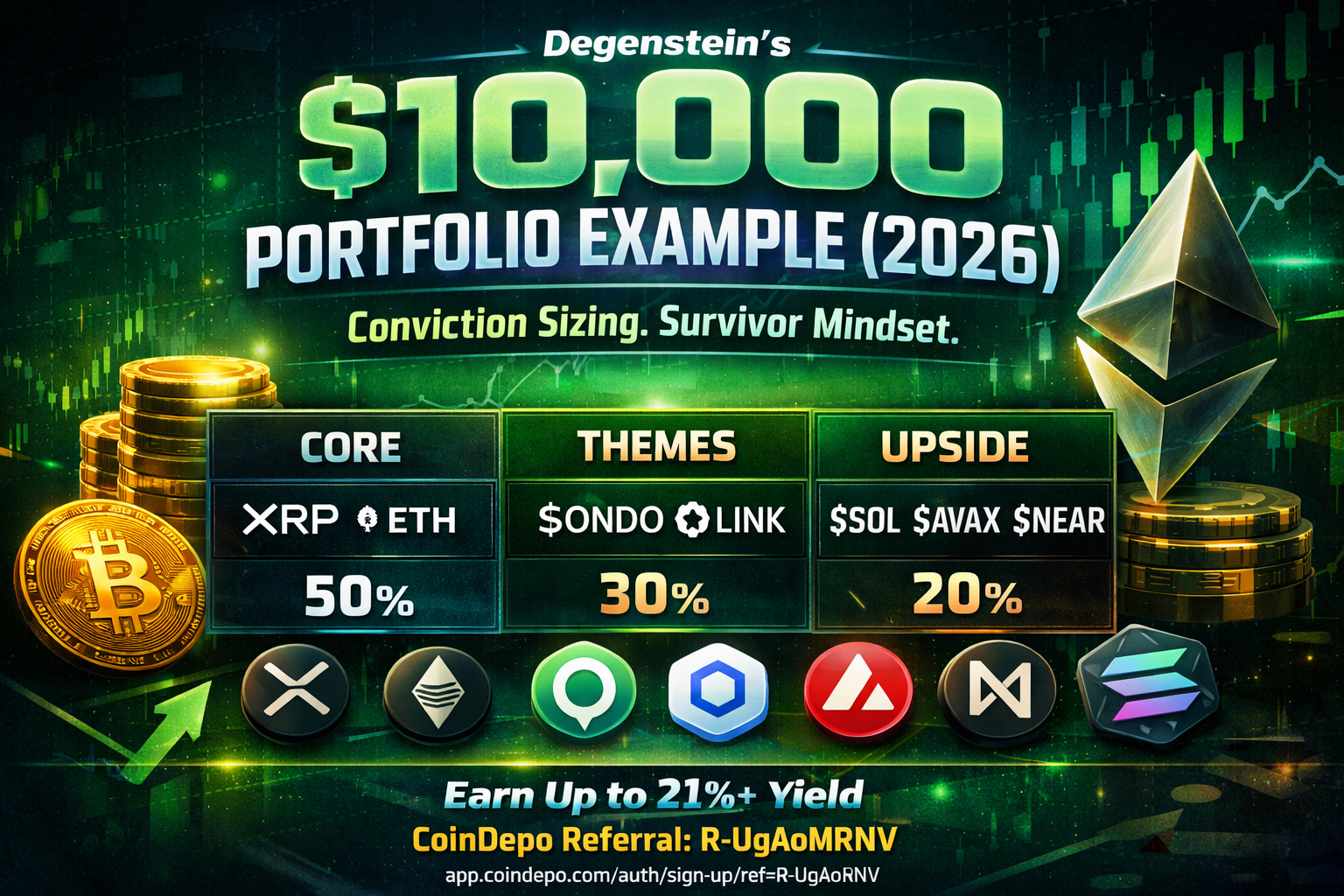
$10,000 Portfolio Example (2026)
This playbook is built for conviction sizing. With $10,000, the edge comes from disciplined concentration,
stronger core exposure, and resisting the urge to over-diversify.
Goal of this playbook
Optimize for survivability and upside in a full-cycle environment. This portfolio leans into assets with institutional relevance, real demand, and multi-year narratives — not short-term hype.
Portfolio structure
- Core (65–75%): assets you can confidently hold through volatility.
- Themes (20–25%): tokenization, infrastructure, and settlement layers.
- Upside sleeve (5–10%): capped exposure to higher-beta L1s.
Suggested allocation (example)
Why these assets
Asset selection in this portfolio is intentional. Each position serves a specific role within the broader structure — balancing network dominance, institutional relevance, and asymmetric upside without relying on speculative narratives alone.
-
$ETH — Core infrastructure layer
Ethereum remains the primary settlement and execution layer for smart contracts, stablecoins, and tokenized assets. Its role as base infrastructure, combined with deep liquidity and developer adoption, makes it a long-term core holding despite cyclical volatility. -
$XRP — Institutional payments & settlement
XRP is positioned around cross-border settlement and liquidity provisioning, particularly in regulated and enterprise contexts. Its focus on payments infrastructure and growing clarity around use cases make it a differentiated non-EVM core asset. -
$SOL — High-throughput execution layer
Solana provides high-speed, low-cost execution optimized for consumer-scale applications. It adds growth exposure to on-chain activity and application demand while remaining large-cap enough to justify meaningful allocation. -
$LINK — Oracle & data infrastructure
Chainlink acts as middleware between blockchains and real-world data. As tokenization and institutional on-chain activity expand, secure data feeds and cross-chain communication become critical infrastructure rather than optional tooling. -
$ONDO — Tokenized real-world assets
Ondo represents exposure to the tokenization of traditional financial products. This allocation targets the convergence of TradFi and crypto, where regulated yield-bearing assets move on-chain. -
$AVAX / $NEAR — Higher-beta infrastructure optionality
This sleeve captures additional upside from alternative Layer 1 ecosystems. Allocation is capped to maintain risk discipline while allowing participation if one network meaningfully outperforms during expansion phases.
Bear case & risks
This portfolio is designed for durability, not certainty. Even with larger-cap assets and institutional narratives, several risks could materially impact outcomes.
- Market structure risk: prolonged risk-off conditions, liquidity tightening, or macroeconomic stress could suppress crypto valuations for extended periods, regardless of fundamentals.
- Regulatory risk: while regulatory clarity is improving in some regions, adverse policy decisions, enforcement actions, or jurisdictional fragmentation could slow adoption or impair specific use cases.
- Execution risk: even strong networks can lose momentum if developer activity, user growth, or ecosystem incentives weaken relative to competitors.
- Narrative risk: themes such as tokenization and institutional adoption may take longer to materialize than expected, or adoption may occur in ways that do not accrue value to public tokens.
Why Bitcoin is not included
Bitcoin is the foundational asset of the crypto market and remains a valid long-term store-of-value allocation for many investors. Its exclusion here is a matter of portfolio design, not a negative view.
This playbook prioritizes assets with direct exposure to on-chain activity, infrastructure growth, and application-driven demand. Bitcoin’s primary role as a monetary asset means it does not directly benefit from trends such as smart contracts, tokenization, or data infrastructure in the same way.
- Lower beta: BTC typically offers less upside relative to altcoins during expansion phases.
- Different role: functions more as digital collateral than programmable infrastructure.
- Opportunity cost: limited capital is allocated toward assets with higher sensitivity to adoption and usage growth.
Where I hold & earn
With a $10,000 portfolio, the objective isn’t constant action — it’s capital efficiency. If I’m holding assets through multi-month or multi-year narratives, I prefer setups that allow capital to earn while I wait.
CoinDepo fits this approach because it’s designed for holders, not traders. Deposits are intentional, terms are defined, and yield compounds in the background without encouraging overtrading or emotional exits.
- Built for patience: choose a term, earn yield, reassess at maturity.
- Clear trade-off: higher APRs come with lockups — plan allocations accordingly.
- Behavioral edge: fewer impulsive trades during volatility.
For a full breakdown of rates, bonuses, and risks, see the CoinDepo deep dive →
Transparency: referral link. APRs, bonuses, and terms vary by asset and region. This is not financial advice.